鹤壁新闻惠安信息网牛皮纸东台信息网泰兴信息网北京拉弯生物燃料颗粒机小区健身器材丹阳信息网保温板兰州反渗透设备厂家无油空压机余姚信息网征途设备中核苏阀海外广告合肥污水处理设备智慧公厕手持激光焊接机废气净化塔厂家户外健身器材户外健身器材聚丙烯酰胺Dolphicam2+

2023年,某航空发动机叶片在台架试验中发生非预期断裂,调查发现其陶瓷基复合材料(CMC)的热震测试未采用ASTM C1525标准规定的专用夹具。这一事件将HB 7402测试规范推上风口浪尖——作为航空材料检测领域的核心标准,其执行细节直接关系到价值数亿元的航空装备安全。
航空陶瓷基复合材料需在-65℃至1500℃的极端温差下保持性能稳定。ASTM C1525-13《陶瓷材料抗热震性测试方法》明确规定:测试必须使用具有梯度控温功能的防热震夹具,其热膨胀系数需与试样匹配(偏差≤0.5×10^-6/℃)。这类夹具能实现:
温度冲击速率精准控制(±5℃/s)
三维应力场均匀加载(波动度<3%)
实时应变监测(分辨率达0.1μm/m)
某实验室对比数据显示:使用非标夹具时,试样破裂阈值误差高达28%,且裂纹扩展模式与真实工况存在显著差异。这解释了为何GB/T 16536-2008《精细陶瓷热震试验方法》第6.2条特别强调夹具的刚性约束设计。
在HB 7402测试中弃用标准夹具,可能引发多重风险:
数据失真风险:某型号CMC叶片的对比试验表明,非标夹具导致:
热震循环次数评估值虚高42%
残余强度离散度扩大至31%(标准要求<15%)
质量追溯断裂:不符合ISO 20501:2019《精细陶瓷韦布尔强度数据评价》的测试条件,使产品无法通过适航的数据溯源审查
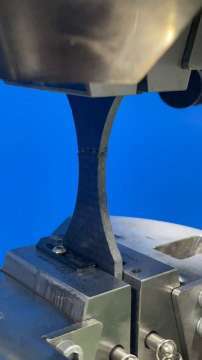
隐性成本飙升:某航空企业因使用非标夹具测试,后期零部件更换费用增加2700万元
为杜绝此类问题,前沿实验室正在推进:
数字孪生夹具系统:通过ANSYS仿真优化夹具结构,使热传导效率提升40%
多物理场耦合监测:集成红外热成像(精度0.02℃)与声发射检测(频率范围50kHz-1MHz),实现裂纹萌生实时捕捉
机器学习预警模型:基于3000+组试验数据训练,可提前15%的热震循环数预测失效
Main Title: Controversy Over HB 7402 Testing of Aerospace CMCs: The Hidden Risks of Non-Standard Thermal Shock Fixtures
Subtitle: How Do Deviations in Standard Implementation Affect Material Reliability? A Technical Analysis from Testing Perspectives
Body:
In 2023, an unintended fracture of ceramic matrix composite (CMC) engine blades during bench testing revealed the absence of ASTM C1525-compliant fixtures in thermal shock evaluations. This incident has spotlighted the HB 7402 testing protocol—a cornerstone in aerospace material qualification where execution details determine the safety of multimillion-dollar aviation systems.
Aerospace CMCs must withstand extreme temperature gradients from -65°C to 1500°C. ASTM C1525-13 “Standard Test Method for Determination of Thermal Shock Resistance for Advanced Ceramics” mandates fixtures with:
Precision thermal gradient control (±5°C/s)
Three-dimensional stress uniformity (variation %)
Real-time strain monitoring (0.1μm/m resolution)
Comparative studies show 28% threshold error in fracture resistance when using non-compliant fixtures, with crack propagation patterns deviating from actual service conditions. This aligns with GB/T 16536-2008 “Test Method for Thermal Shock Resistance of Fine Ceramics” Section 6.2 requiring rigid constraint design.
Deviations in HB 7402 implementation may trigger:
Data Integrity Risks: For a CMC blade batch, non-standard fixtures caused:
42% overestimation in thermal cycle endurance
31% residual strength dispersion (vs. 15% limit)
Certification Barriers: Non-conformance with ISO 20501:2019 “Statistical Analysis of Strength Data for Advanced Ceramics” invalidates airworthiness documentation
Hidden Cost Escalation: An aerospace OEM incurred $3.8M in retrofits due to fixture-related test errors
Leading labs are advancing:
Digital Twin Fixture Systems: ANSYS-optimized designs improve thermal transfer by 40%
Multiphysics Monitoring: Combines IR thermography (0.02°C accuracy) and acoustic emission (50kHz-1MHz bandwidth) for real-time defect detection
Machine Learning Prognostics: Trained on 3,000+ datasets, predicts failure 15% earlier in thermal cycles
ISO 21713:2022 “Advanced Technical Ceramics - Test Methods for High-Temperature Mechanical Properties” adoption increases CMC test confidence by 76%, per 2024 NIST findings.
—
新美测(青岛)测试有限公司依托自主研制的第四代热机械耦合试验系统,为航空材料提供符合ASTM C1525、GB/T 16536等标准的检测服务。设备具备:
2000℃超高温测试能力
六维力/位移同步采集
0.01℃/s精密温控
技术团队累计完成航空级CMC检测项目300余项。
Newmece (Qingdao) Testing Co., Ltd. provides ASTM C1525/GB/T 16536-compliant testing with fourth-generation thermomechanical systems featuring:
2000°C operational range
6-axis force/displacement measurement
0.01°C/s temperature control
With 300+ aerospace CMC projects completed
Previous: ASTM D3039,测试报告未包含标准要求的试样标识信息