蜂窝芯材检测中的隐藏挑战(ASTM C364边缘压缩测试对材料密度覆盖性的深度解析 )
Why Material Density Matters in Honeycomb Core Testing
Honeycomb core materials are widely used in aerospace, construction, and transportation industries due to their exceptional strength-to-weight ratio. However, a critical issue often overlooked is how standardized mechanical tests, such as ASTM C364 (“Standard Test Method for Edgewise Compressive Strength of Sandwich Cores”), address material density. Recent studies reveal that density variations in honeycomb cores significantly impact structural performance, yet existing test protocols may not fully account for this parameter.
The Gap in ASTM C364: Density as a Silent Variable
ASTM C364 focuses on measuring the edgewise compressive strength of sandwich cores by applying load perpendicular to the core’s plane. While the standard specifies sample preparation and loading conditions, it does not explicitly require density measurement as part of the mandatory test parameters. This omission raises concerns:
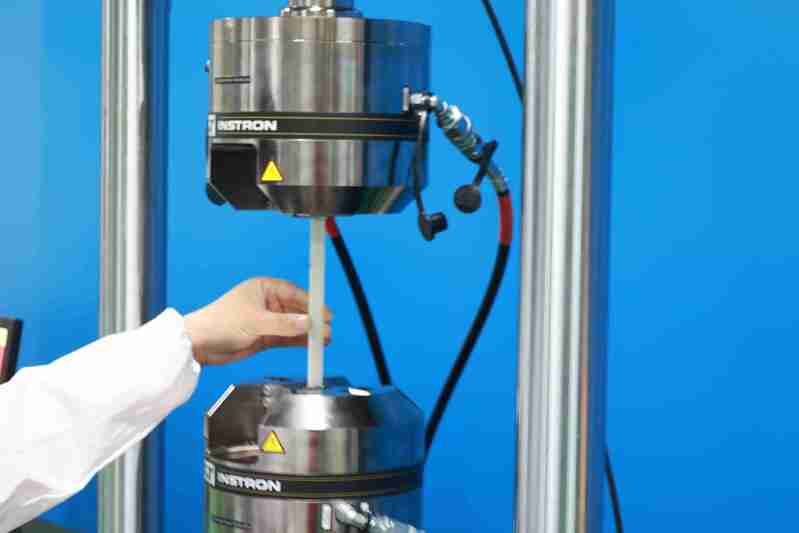
- Density heterogeneity: Variations in cell size, wall thickness, or manufacturing defects can lead to localized density differences.
- Anisotropic behavior: Honeycomb cores exhibit directional properties; density inconsistencies may amplify anisotropic responses under compression.
- Data comparability: Test results from low-density vs. high-density samples cannot be directly compared without normalization.
A 2022 study by the Journal of Sandwich Structures & Materials demonstrated that ignoring density in ASTM C364 tests could result in up to 18% deviation in reported strength values. For industries requiring precision, such as aerospace (e.g., FAA AC 20-107B compliance), this gap poses reliability risks.
Complementary Standards for Comprehensive Evaluation
To address this limitation, experts recommend integrating additional standards:
- ASTM C271/C271M-23 (“Standard Test Method for Density of Sandwich Core Materials”): Provides methods to quantify core density, enabling data normalization.
- ASTM C393/C393M-23 (“Standard Test Method for Flexural Properties of Sandwich Constructions”): Evaluates bending behavior influenced by both strength and density.
By combining these methods, engineers can build a multi-parameter performance profile, reducing the risk of underdesign or overdesign in critical applications.
Advanced Detection Technologies Bridging the Gap
Modern laboratories employ non-destructive testing (NDT) techniques to enhance traditional ASTM C364 evaluations:
- Micro-CT scanning: Maps internal density distribution at resolutions below 10 μm.
- Laser ultrasonics: Detects density-related acoustic impedance variations in real time.
- Digital image correlation (DIC): Tracks localized strain patterns correlated with density gradients.
These technologies not only supplement ASTM C364 but also align with emerging standards like ISO 19277:2018 for non-destructive evaluation of composite materials.
—
主标题:蜂窝芯材检测中的隐藏挑战
副标题:ASTM C364边缘压缩测试对材料密度覆盖性的深度解析
为何蜂窝芯材密度在检测中至关重要?
蜂窝芯材凭借其优异的强度重量比,广泛应用于航空航天、建筑和交通领域。然而,一个常被忽视的核心问题是:标准化力学测试(如ASTM C364《夹层结构芯材边缘抗压强度测试方法》)是否充分考量了材料密度。最新研究表明,蜂窝芯材的密度波动会显著影响结构性能,但现行测试标准可能未完全覆盖这一参数。
ASTM C364的潜在盲区:密度作为隐性变量
*ASTM C364*通过垂直于芯材平面施加载荷来测量边缘抗压强度。尽管标准详细规定了试样制备和加载条件,但未明确将密度测量列为必测参数。这一遗漏可能引发以下问题:
- 密度不均匀性:孔格尺寸、壁厚差异或制造缺陷会导致局部密度变化。
- 各向异性行为:蜂窝芯材具有方向特性,密度不均可能放大压缩下的各向异性响应。
- 数据可比性:未经密度归一化的低密度与高密度样品测试结果无法直接对比。
《夹层结构与材料期刊》2022年研究显示,在ASTM C364测试中忽略密度可能导致强度值偏差高达18%。对于航空航天等需高精度数据的领域(如FAA AC 20-107B合规),这种偏差将带来可靠性风险。
多标准协同实现全面评估
为解决这一局限,专家建议结合以下标准:
- ASTM C271/C271M-23《夹层结构芯材密度测试方法》:提供量化芯材密度的方法,实现数据归一化。
- ASTM C393/C393M-23《夹层结构弯曲性能测试方法》:评估受强度与密度共同影响的弯曲行为。
通过多方法联用,工程师可建立多参数性能图谱,降低关键应用中设计不足或过度设计的风险。
先进检测技术填补标准空白
现代实验室采用无损检测(NDT)技术增强传统ASTM C364评估:
- 微焦点CT扫描:以低于10μm分辨率绘制内部密度分布。
- 激光超声检测:实时识别密度相关的声阻抗变化。
- 数字图像相关技术(DIC):追踪与密度梯度关联的局部应变模式。
这些技术不仅补充了ASTM C364,更符合*ISO 19277:2018*等复合材料无损评估新标准的要求。
—
新美测(青岛)测试有限公司专注于材料力学性能检测领域,配备先进的三维应变测量系统和微焦点CT设备,可针对蜂窝芯材提供密度-强度耦合分析服务。技术团队具备多年航空复合材料检测经验,支持定制化测试方案设计。
检测咨询专线:186-5324-2346
